
 Streamline
 Any construction project that involves placing large volumes of concrete demands the right equipment. Shovels and wheelbarrows have their place on smaller jobs, but when you are pouring a foundation, building a multi-story structure, or working in a location that is difficult to access, a concrete pump becomes not just convenient but essential. For most contractors and homeowners, renting a concrete pump is the smartest way to get that capability without carrying the financial burden of ownership. This guide covers everything you need to know about concrete pump rental, from choosing the right pump to understanding costs, hidden fees, and whether renting actually makes sense for your situation.
What Is a Concrete Pump and How Does It Work?
A concrete pump is a piece of heavy construction equipment designed to transfer liquid concrete from a mixer truck directly to the exact spot where it needs to be placed. Instead of manually transporting wet concrete across a job site using labor and handheld tools, a pump moves the material through pipes or hoses under pressure, delivering it quickly and precisely to foundations, elevated floors, walls, or any other hard-to-reach area.
The process starts when ready-mix concrete is discharged from the delivery truck into the pump’s hopper. The machine then pushes the concrete through a pipeline to the pour location. Depending on the type of pump, that pipeline might be a flexible rubber hose directed by a worker on the ground or a long mechanical boom arm that positions itself remotely. The result is a faster, cleaner, and more accurate pour compared to any manual alternative.
Types of Concrete Pumps Available for Rent
Understanding which type of pump fits your project is the most important decision you will make before picking up the phone to call a rental company. Getting the wrong pump can mean paying more than necessary or, worse, finding out on pour day that the equipment cannot reach where you need it to go.
Boom pumps are truck-mounted units equipped with a large remote-controlled articulating arm that extends and folds like a series of hinged sections. They are the most powerful option available and are best suited for high-rise buildings, large commercial pours, or any site where concrete must be placed at significant height or horizontal distance. The reach of a boom pump can range from around 20 meters on smaller units to over 60 meters on the largest models. Their power and versatility make them the most expensive rental option, but for the right job, nothing else comes close.
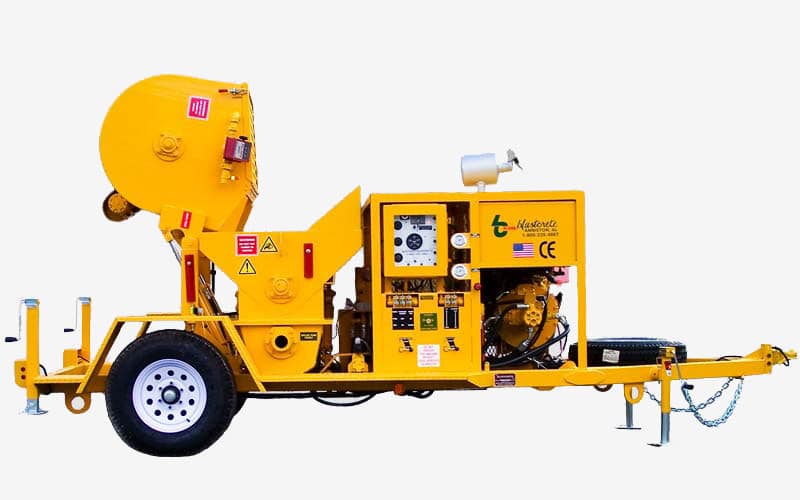
Line pumps, also called trailer-mounted pumps, are a more compact and affordable alternative. They do not have a boom arm. Instead, flexible rubber hoses are attached to the pump outlet and manually guided to the pour location by workers on site. Line pumps are well suited for residential slabs, swimming pools, sidewalks, low-rise projects, and anywhere that requires maneuverability rather than extreme reach. They cost less to rent, are easier to position on tight job sites, and can handle a wide range of concrete mixes.
Mini concrete pumps are a compact variation designed specifically for small-scale or difficult-to-access work. They are portable, easy to operate in confined spaces, and ideal for indoor applications, basement pours, or residential projects where a full-sized pump would be impractical. Despite their smaller footprint, mini pumps are capable of handling most standard concrete mixes and offer a cost-effective solution for jobs that do not require high volume output.
Specialty pumps exist for unique project requirements such as high-volume industrial pours, shotcrete applications, or mixes with unusual additives. These are less commonly available from standard rental companies but can be sourced through specialist equipment providers when the job calls for them.
How Much Does Concrete Pump Rental Cost?
Rental pricing is one of the most confusing aspects of the process because it is structured differently from renting everyday equipment like a generator or a forklift. In most markets, concrete pump rental is priced as an operated service, meaning the pump comes with a trained operator included in the rate. Bare equipment rentals without an operator are available in some markets but are far less common and generally only offered to contractors with their own certified pump operators on staff.
For standard operated service, professional concrete pumping costs between $800 and $1,800 for a typical residential project, with prices starting as low as $400 for very small jobs and exceeding $3,500 for large or complex pours. On a per-unit basis, expect to pay roughly $3 to $10 per cubic yard or $150 to $250 per hour depending on pump type and project details.
Line pump rental generally runs $800 to $2,000 per day for operated service. Boom pump rental in the 28 to 38 meter range costs $1,500 to $3,000 per day, while larger boom pumps in the 42 to 56 meter class run $2,500 to $5,000 per day or per pour. If you are renting bare equipment without an operator, rates typically fall in the $300 to $800 per day range, but this option requires your team to have genuine experience with concrete pumping equipment.
Long-term rentals offer considerably better value for extended projects. A daily rate of $500 over 10 days adds up to $5,000, while a monthly agreement at $6,500 could cover 20 or more working days at a significantly lower per-day cost. If your project spans several weeks or months, always discuss monthly pricing with the rental company.
Hidden Fees That Can Inflate Your Invoice
This is where most contractors get caught off guard. The base rental rate is rarely the number that appears on your final invoice. Understanding the full billing structure before you commit can save you hundreds or even thousands of dollars.
Most providers charge a minimum time block regardless of how long your pour actually takes, typically covering three to four hours. If your pour finishes in 90 minutes, you are still paying for the minimum. Setup and first-hour bundle charges commonly fall in the $300 to $650 range and are separate from your hourly rate. Hose extension fees apply when your pour requires more reach than the standard included hose length, often billed at around $2.50 per foot beyond the first 200 feet.
Travel is another significant variable. Some providers bill port-to-port, meaning the clock starts when the truck leaves their yard and does not stop until it returns. In congested urban areas, this can add one to two hours of billable time before and after the actual work on your site. Fuel surcharges, environmental fees, and late cancellation penalties are also common and can range from $35 to $300 or more depending on the provider and the circumstances.
Always ask your rental company to walk you through their complete billing structure before booking. Request a written quote that breaks down every line item, including mobilization, minimum hours, travel billing, hose fees, and any surcharges.
Short-Term vs. Long-Term Rental: Choosing the Right Duration
Short-term rentals measured in days or weeks offer flexibility and a low upfront commitment, making them ideal for one-time pours, emergency jobs, or seasonal work. The trade-off is a higher daily rate, and during peak construction season, availability can become an issue if you book late.
Long-term rentals spanning several months provide lower per-day costs, guaranteed equipment availability throughout your project, and operational consistency since your crew works with the same machine regularly. The downside is that you remain locked into the agreement even if work slows down, meaning idle days still cost money. For ongoing commercial construction or contractors with continuous concrete placement needs, long-term rental usually delivers better value overall.
Rent vs. Buy: When Does Ownership Make More Sense?
For most contractors and virtually all homeowners, rental is the right answer. Purchasing a high-quality concrete pump requires an upfront investment of $20,000 to $50,000 for most standard models, plus ongoing costs for maintenance, storage, insurance, and operator training. Unless concrete pumping is a central and frequent part of your business operations, that capital is better deployed elsewhere.
Ownership starts to make financial sense when you are regularly using a pump across a high volume of jobs throughout the year. If your business handles several hundred concrete projects annually and requires a pump for a significant portion of them, the cumulative cost of rental fees can eventually exceed the cost of ownership. At that point, having your own equipment also eliminates the scheduling uncertainty that comes with relying on outside rental availability.
Practical Tips for a Smooth Rental Experience
Book early. Concrete pump availability tightens considerably during peak construction months, and last-minute requests are often turned away or result in higher rates. Research the rental company’s maintenance standards and ask how they handle breakdowns, since an equipment failure mid-pour can cost you far more than the rental fee itself in wasted labor, standby concrete charges, and project delays.
Prepare your site before the pump arrives. Ensure there is adequate space for the truck to position and extend safely, that access roads can support the weight of the vehicle, and that your concrete mix is pumpable and arriving on schedule. Delays caused by site conditions or late ready-mix deliveries result in additional billable hours that add directly to your costs.
Final Thoughts
Concrete pump rental is a practical, efficient, and cost-effective solution for a wide range of construction projects. Whether you are a homeowner tackling a one-time foundation pour or a contractor managing ongoing commercial work, renting gives you access to professional-grade equipment without the overhead of ownership. Understanding pump types, pricing structures, hidden fees, and rental duration options puts you in full control of your budget and helps ensure that pour day goes exactly as planned.

